Spark Notes
My Electrolyte Journey

Disclosure:
I am a Metabolic Health Coach committed to providing education that empowers you to make informed decisions about your well-being. I am not a licensed medical provider and therefore do not offer guidance on medications or supplements. For any questions regarding your prescriptions, supplements, or treatment plans, please consult with your healthcare professional, especially if you’re currently taking medication.
Spark Notes: My Electrolyte Journey
Electrolytes have come up in nearly every conversation I’ve had since starting a low-carb diet. Early on, I learned how essential they are—and how my body responds when they’re missing. I began supplementing with LMNT, a popular commercial electrolyte blend in my circle.
I started with the flavored pouches. This product was everywhere—shared in group chats, recommended in forums, even handed out during a live Q&A I co-hosted. I felt good taking one pack a day. Sometimes two.
But on those double-pack days, something curious happened: my body and brain started signaling me. I noticed I drank more water, but it wasn’t just hydration—I was craving sweetness.
That desire to have more LMNT felt... addictive.
So I gradually transitioned to LMNT’s unflavored version. Over time, though, I noticed I was drinking less water. To strike a balance, I began mixing one flavored and one unflavored packet, splitting the blend across two days. That softened the sweet intensity and worked well—until Fall 2024.
The Maltodextrin Reveal
From mid-summer through October, a heated controversy erupted online. Someone uncovered that LMNT’s “no dodgy ingredients” claim wasn’t entirely true; the flavored mix contained maltodextrin.
Maltodextrin is a processed food additive used to enhance texture, flavor, and shelf life. It can be derived from corn, potato, wheat, tapioca, or rice. The issue? It spikes blood sugar—bad news for anyone with insulin resistance or diabetes. It’s also known to kick people out of ketosis.
Suddenly, my cravings made sense. The sweet flavor lit up the reward centers of my brain, and I fanned the flames of addiction.
🧂Saltt: A New Electrolyte Contender
Around the same time, I was introduced to Saltt, another electrolyte brand that claimed to be maltodextrin-free. Their formula was noticeably different from LMNT’s.
Here’s a quick comparison:
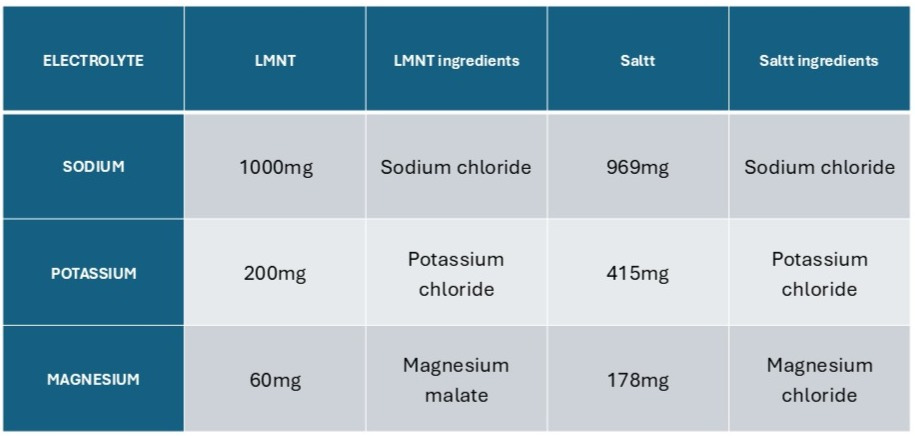
Sodium levels were similar, but Saltt offered more than double the magnesium and potassium. I’d read that sodium acts as the “gatekeeper” for electrolyte balance—when it’s optimal, the body retains magnesium, potassium, and calcium. But some influencers argue magnesium is the real MVP and we need to replenish it daily.
Curious and hopeful, I gave Saltt a try.
🧩 The Magnesium Mystery
For the first two weeks, I felt great. My energy surged, inflammation dropped, and I was optimistic.
But around day 14, I noticed a change. My joints ached. Muscles stiffened. Walking downstairs became a struggle. I just didn’t move freely. My fingernails softened and tore easily.
I needed to figure out what was happening.
Soft nails are often a sign of low calcium, so I started supplementing with eggshells. It helped, I regained some nail strength—but didn’t fully resolve the joint pain and stiffness during movement. Digging a little deeper into magnesium, I learned that an excess can block calcium absorption and activity.
That clicked. I was taking in too much magnesium. It interfered with muscle contraction (movement) and robbed my fingernail of its strength matrix.
I stopped using Saltt—and within days, my symptoms reversed. My energy returned, stiffness faded, and my nails regained their strength.
Still, the online chatter was loud: “We’re all magnesium deficient!”
I second-guessed myself —several times—especially when I couldn’t sleep—and returned to Saltt.
Guess what? All the same symptoms returned.
🔍 Coming Up Next
In the posts ahead, we’ll explore:
What cravings, cramps, and fatigue might be trying to tell you
Simple ways to support your electrolyte balance—without overwhelm
⚡️ Why Your Cells Speak in Sparks: An Introduction to Electrolytes
You’ve probably heard the word “electrolytes” tossed around in ads for sports drinks or hangover cures. But here’s the truth: electrolytes aren’t just for athletes or emergencies. They’re the conductors of your body’s electrical current—guiding energy (metabolism), mood, hydration, and even how your heart beats.
If you’ve ever felt foggy, fatigued, or oddly thirsty despite drinking water, your electrolytes might be crying for attention.
🌊 What Are Electrolytes, Really?
Electrolytes aren’t just buzzwords tossed around in fitness circles; they are the micronutrient lifeguards of your internal ocean. These charged minerals—sodium, potassium, magnesium, calcium, and others—are essential for keeping your body’s electrical system humming.
Think of them as the conductors of your cellular symphony. Every heartbeat, every muscle twitch, every thought firing across a neural pathway depends on electrolyte presence and balance.
Here's what they do behind the scenes:
Send Nerve Signals: Electrolytes help neurons transmit messages. Without them, your brain’s instructions wouldn’t reach your muscles, organs, or even your thoughts.
Contract Muscles: From blinking to sprinting, muscle movement requires calcium and sodium to initiate contraction, and potassium to help muscles relax.
Balance Fluids: Sodium and potassium regulate how much water your cells hold or release. This affects everything from blood pressure to hydration status.
Regulate pH & Energy Production: Magnesium plays a key role in ATP synthesis—the energy currency of your cells; while other electrolytes help maintain the delicate acid-base balance your body needs to function.
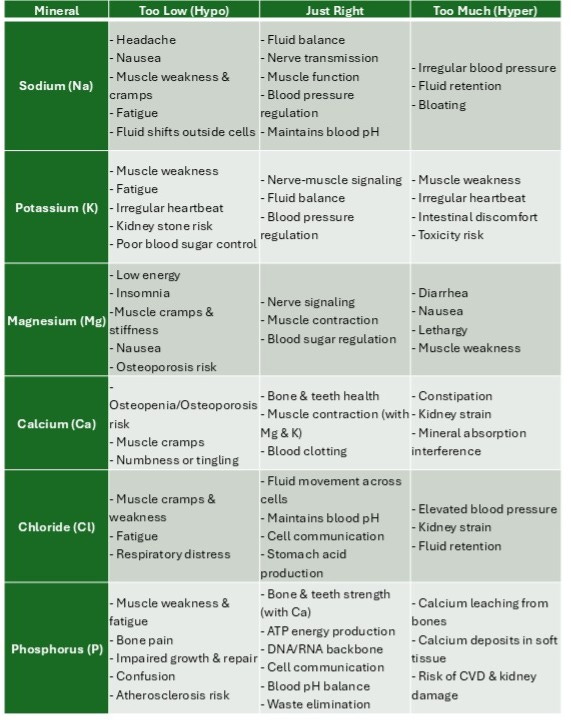
[I created a quick cheat-sheet chart as a visual reference. It is at the end of this publication.]
When these minerals are out of sync, symptoms can range from subtle fatigue to dramatic shifts in mood, cognition, and physical performance. And on a low-carb or ketogenic diet, your body flushes electrolytes more rapidly, making intentional replenishment not just helpful, but vital.
Let's look at each of the 5 electrolytes to see what they do for the body, and what the consequences of over- or underconsumption can be.
🧂 SODIUM: The Mineral Gatekeeper
Sodium is like the body's internal gatekeeper of other electrolytes, directing fluid movement, nerve signals, and muscle contractions with precision. But just like traffic, too much or too little can cause chaos. Here's a full breakdown:
Sodium is an essential electrolyte that plays several critical roles:
Fluid balance: Works with potassium to regulate water distribution inside and outside cells.
Nerve transmission: Helps generate and transmit electrical impulses in nerves.
Muscle function: Enables proper contraction and relaxation of muscles, including the heart.
Blood pressure regulation: Influences vascular tone and volume, impacting blood pressure.
Acid-base balance: Helps maintain pH levels in the blood.
🍌 POTASSIUM: The Rhythm Keeper
Potassium keeps your body’s rhythm steady—from your heartbeat to your hydration. It’s the counterbalance to sodium and a key player in cellular communication.
Regulating nerve signals: It helps transmit electrical impulses between cells, especially in nerves and muscles.
Supporting heart function: Potassium helps your heartbeat regularly by balancing electrical activity.
Facilitating muscle contractions: Including skeletal muscles and the heart muscle.
Maintaining fluid balance: Works with sodium to regulate hydration inside and outside cells.
Controlling blood pressure: A potassium-rich diet can blunt the effects of sodium and help lower blood pressure.
Preventing kidney stones and bone loss: It may reduce the risk of kidney stones and slow age-related bone demineralization.
🌿 MAGNESIUM: The Master Regulator
Magnesium plays a role in over 300 enzymatic reactions, including nerve signaling, muscle contraction, and blood sugar regulation. So when it’s low, your whole system can feel off-kilter.
Navigating the Magnesium Maze
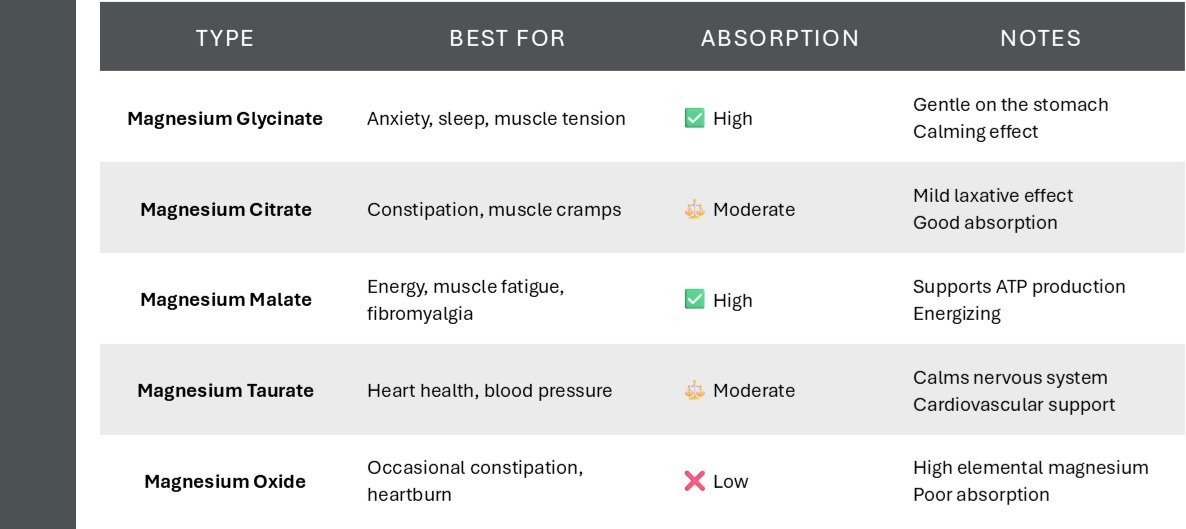
The magnesium supplement market can feel overwhelming—and for good reason. Magnesium must be bound to a carrier molecule to remain stable and absorbable, and different companies use different carriers depending on their intended effect. Each pairing influences how magnesium behaves in the body, from calming the nervous system to supporting energy metabolism.
Below is a breakdown of common magnesium forms and the unique benefits each carrier brings to the table—so you can choose the one that best supports your goals.
Top Magnesium Types & Their Benefits
🦴 CALCIUM: The Structural Architect
Calcium is the body’s structural architect, fortifying bones, coordinating muscle movements, and even helping your heartbeat. But like any good architect, it needs balance. Too little and the foundation crumbles; too much and the system gets clogged. Let’s break it down:
Calcium is the most abundant mineral in the body, and its roles go far beyond bone health:
Builds and maintains bones and teeth: About 99% of calcium is stored in bones and teeth, providing strength and structure.
Regulates heart rhythm: Essential for proper contraction of the heart muscle.
Supports nerve transmission: Helps carry electrical signals between cells.
Enables muscle contraction: Works with magnesium and potassium to coordinate movement.
Assists in blood clotting: Activates proteins that help stop bleeding.
Influences enzyme activity: Acts as a cofactor in many cellular processes.
🧪 CHLORIDE: The Quiet Balancer
Chloride is the unsung electrolyte that quietly keeps your body’s internal chemistry humming. It works in tandem with and is often overshadowed by sodium and potassium, but it plays a vital role in maintaining balance—literally and chemically.
Its key roles include:
Fluid balance: Chloride helps regulate the movement of fluids in and out of cells, especially in extracellular spaces.
Acid-base balance: It’s crucial for maintaining proper pH levels in the blood.
Nerve and muscle function: Supports electrical activity and communication between cells.
Digestive support: Combines with hydrogen to form hydrochloric acid (HCl) in the stomach, which breaks down food and kills pathogens.
Blood pressure regulation: Works with sodium to influence vascular tone and fluid retention.
Most chloride enters the body as sodium chloride (table salt), but it also appears in foods like seaweed, shrimp, and processed items.
While dietary toxicity is rare in healthy individuals, chloride levels can spike in those with kidney disease or metabolic disorders.
⚙️ PHOSPHORUS: The Energetic Scaffold
Phosphorus is like the body's energetic scaffolding—quietly powering cellular processes while reinforcing structural integrity. It’s essential, abundant, and often underestimated as it is found in every cell, mostly as phosphate. Let’s unpack its role and the risks of imbalance:
Phosphate is involved in:
Bone and teeth formation: About 85% of phosphorus is stored in bones and teeth, working with calcium to form strong structures.
Energy production: It’s a key component of ATP (adenosine triphosphate), the molecule that fuels nearly every cellular function.
DNA and RNA synthesis: Phosphorus is part of the backbone of genetic material.
Nerve signaling and muscle function: Supports proper communication between cells.
Acid-base balance: Acts as a buffer to maintain blood pH.
Waste elimination: Helps kidneys filter and excrete waste products.
Electrolyte supplementation typically focuses on sodium, potassium, and magnesium, as these are more readily excreted through urine—especially on low-carb or ketogenic diets. While potassium and magnesium are found in whole foods, their bioavailability can vary, and magnesium is often paired with other compounds to aid absorption. Sodium, on the other hand, is less abundant in unprocessed foods and often needs intentional replenishment. If you like your salt, use a natural, multi-mineral salt like Celtic Sea Salt or Redman’s Real Salt.
Whether this article clarified or complicated things, I hope it planted a seed: that your body’s needs are worth exploring. I won’t pretend it solved the electrolyte puzzle, but maybe it “sparked: a question or two—or a desire to look beyond the label. Start simple. Stay curious. Perhaps, let your palate guide you: salt to taste, with trust.
Knowledge is Power:
It's what we do with that knowledge that truly matters.
I encourage you to take the insights gained from today's episode and apply them. If you want additional support, connect with me on social media or visit my website to leave your thoughts, comments, and suggestions.
Until next time, remember to keep seeking knowledge with curiosity rather than judgment.
Together, we can create a better future.
Website: https://www.startwellstaywell.com/
Email: startwellstaywell@gmail.com
LinkedIn: www.linkedin.com/in/kelley-b-sauber-14b17a27 Facebook Page: https://www.facebook.com/share/g/16aCSy1rTR/
Electrolyte Balance Cheat Sheet